







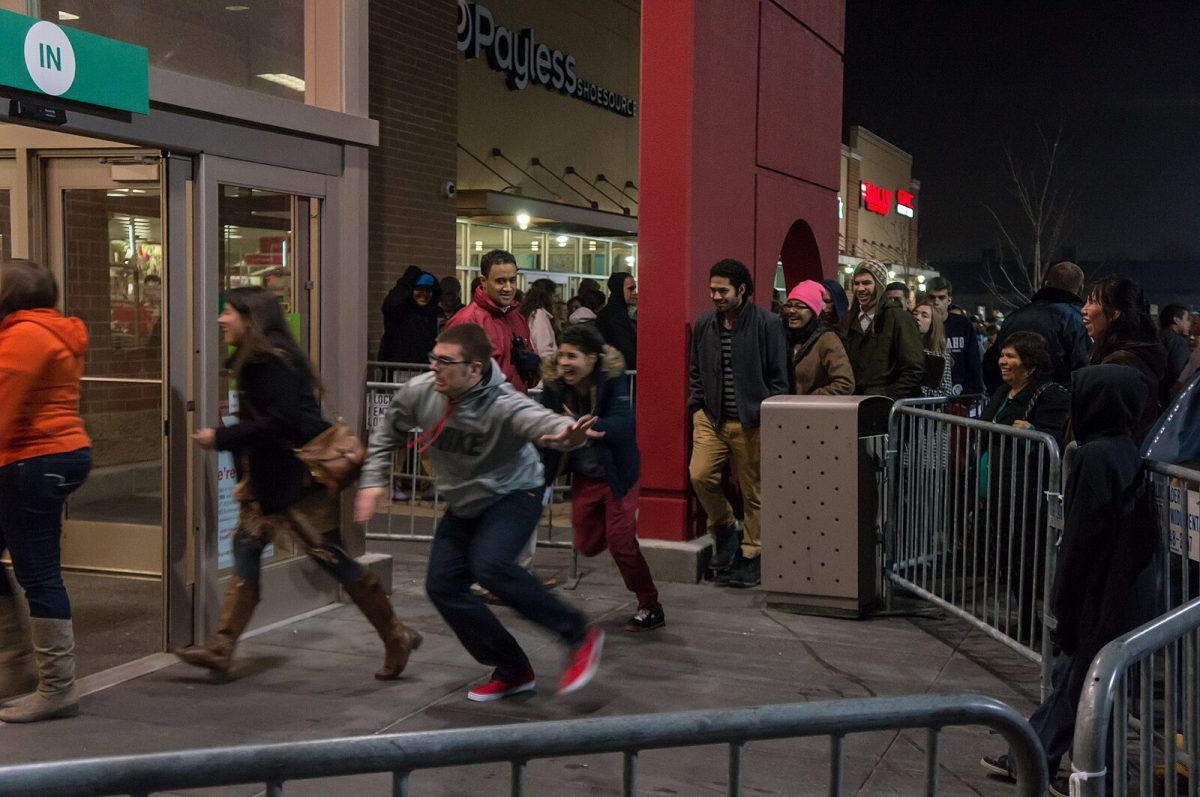
Bodies crush against each other in a desperate scramble. Lines trail out of brick-and-mortar stores long before sunrise. People scrabble, cut lines, and crush each other’s feet. Since the 1900s, Black Friday has cemented its reputation as a mad dash for mega-sales. But the truth is that with the rise of online shopping, dishonest pricing, and subpar discounts, the “holiday” no longer serves shoppers. Hype is all it brings; we should retire the frenzy in favor of transparent, year-round pricing.
Black Friday has a long history. Its first recorded use in 1869 described an orchestrated stock market crash rather than the discount event it is now. The first time shoppers were exposed to the term was in the 1950s when Philadelphia police used it to describe the craze of shoppers and tourists that flooded the city in anticipation of the Navy-Army football game hosted the Saturday after Thanksgiving. But it wasn’t until the 1980s that the term became associated with retail store shopping nationwide.
Since then, Black Friday has been memorialized as America’s retail holiday. But that memorial has become a museum piece. Sensormatic Solutions, an in-store traffic analytics firm whose sensors count people at mall and store entrances, reported that 2021 Black Friday visits fell 28.3% below 2019. In 2024, Sensormatic said Black Friday week visits fell 2.3% from 2023. Further, Adobe Analytics, the e-commerce measurement part of Adobe that tracks purchases across a trillion site visits, found that online spending set records: $10.8 billion on Black Friday 2024 and $13.3 billion on Cyber Monday. Both trends are a sane correction to the crisis that is Black Friday.
According to the United States Department of Commerce, as in-person shopping decreases, online shopping on Black Friday has conversely increased. But platforms that offer online Black Friday shopping have been accused of inflating prices to make Black Friday sales more appealing, some shoppers noticing steep price hikes directly before Thanksgiving. How can this deceptive marketing technique where prices are anchored so high that a “deal” feels generous be considered a holiday? It cannot, and shoppers should assume a discount is fake until proven otherwise by price-tracking history. Consumers have also noticed a decrease in discount rates with 2024’s average settling at around 28%. Black Friday has lost its value.
Despite all of its downfalls, Black Friday still offers opportunities to get large discounts on year-round products such as streaming subscriptions or pet supplies. Genuine outliers in targeted deals on staples that a person already plans to buy do exist, but they are just that: outliers. They do not change the fact that Black Friday is mostly a marketing spectacle propped up by inflated “original” prices and minute markdowns to manufacture urgency.
If retailers are confident that their prices are fair, they should have no problem introducing guardrails like year-round rolling product history, defining and proving “list price,” clearly disclosing the total cost of a product (shopping, fees, and restocking), verifying their inventory before marketing of “only a few left,” and abolishing drip pricing. The smart move for consumers is to buy on their own timeline, use price-tracking history, and stick to a pre-set list and budget. If a real need lines up with a real discount, take it; otherwise, save the money by skipping the scrum of an overrated Black Friday and pushing for policy requiring companies to institute transparent year-round pricing instead.